

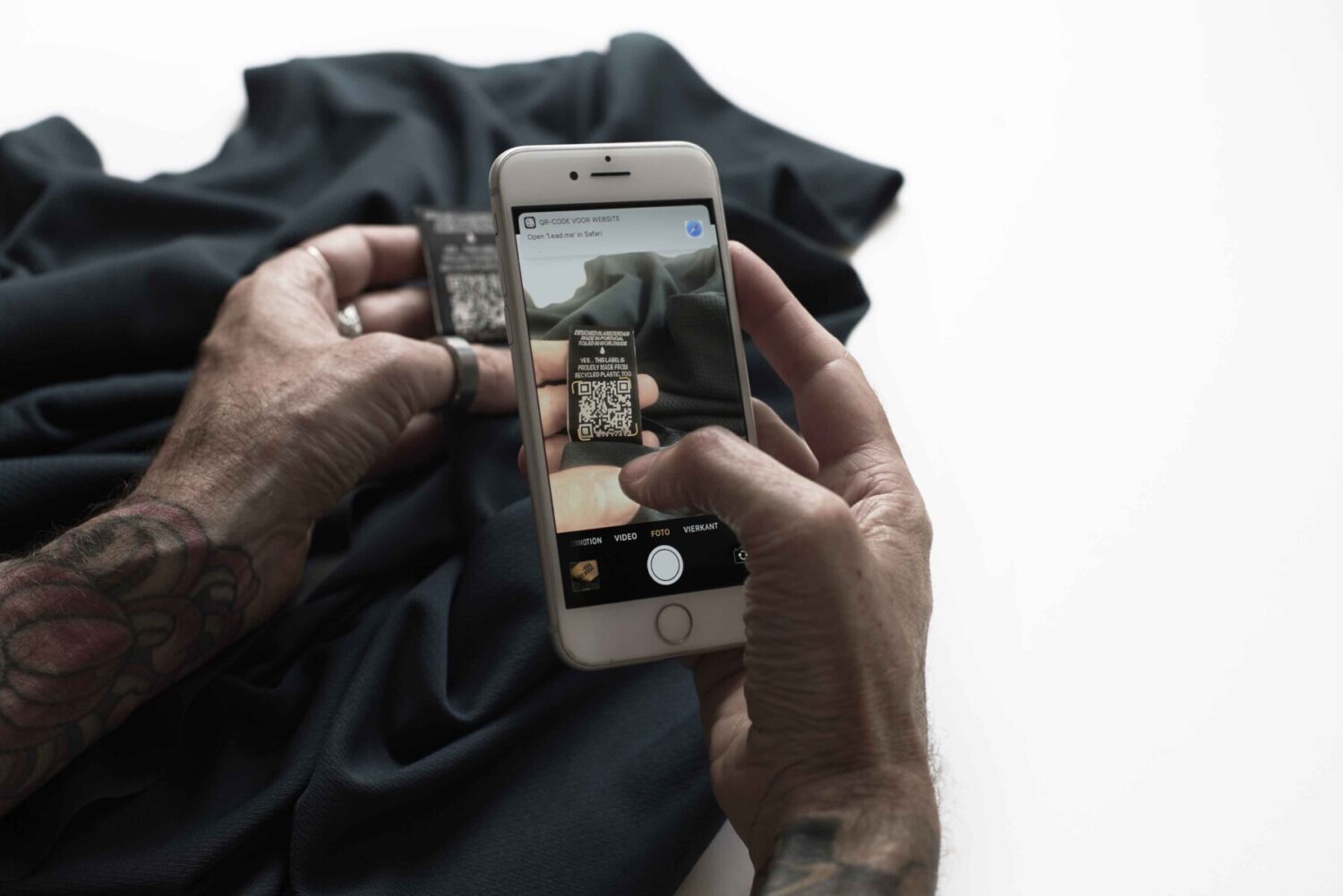
In the world of the Digital Product Passport (DPP), there was a long-standing challenge: how do you combine unique, woven QR codes at the item level with global GS1 standards while creating a digital product identity for each article? Until recently, producing unique codes was complex and costly because each item had to be known in advance and produced individually. This often conflicted with the minimum batch sizes of weaving machines, making it impossible for many brands.
The breakthrough: mass production with on-demand linking. Thanks to the introduction of serialized GTIN, this problem is now solved. It is now possible to produce large quantities of unique QR codes at once, without pre-defining the item details. These unique codes can later be seamlessly linked to the correct product information, giving each item a complete digital product identity.
In this blog, we explain how this innovation not only creates enormous efficiency gains in production but also opens the door to full traceability and new commercial opportunities at the item level.
What is GS1?
GS1 develops global standards so companies can uniquely identify, share, and track products across the supply chain. This is mostly done using the well-known GTIN code (EAN). This code contains information such as country, company, product (e.g., size or color), etc. While effective, one major limitation remained: identification was possible only at the batch level, not for individual items.
This limitation meant that brands missed out on valuable data at the item level:
No individual traceability
- No link between product and customer
- No insight into behavior per individual product
No product history per item
- No insight into usage, wear, or lifespan
- No data on repairs, returns, or recycling
Limited customer interaction and commercial opportunities
- No personalized content per item
- Fewer opportunities for upselling and cross-selling
Why this is a problem
Data is today one of a brand’s most valuable assets. Working only at batch level provides only general insights, whereas real insights come from item-level data.
This was also a practical problem for unique woven QR codes. Each code had to be produced individually, while weaving machines have a minimum batch size of approximately 2,500 pieces. In practice, quantities per item are often much lower, making it unfeasible for many brands.
The absence of a clear digital product identity per item further complicated this process.
The Solution: Serialized GTIN for Digital Product Identity
GS1 solved this by adding a serial number to the GTIN, known as serialized GTIN.
How does it work?
- Start with an existing GTIN (EAN)
- Add a unique serial number (e.g., 0000000001, 0000000002…)
- This combination is converted into a unique 24-character code (EPC)
Example:
GTIN + serial number → 302593D1ED6F80803B9ACA00
Each following code counts automatically, allowing millions of unique codes.
Why this matters
The big advantage: no more pre-producing stacks of labels per product group.
Instead, you can:
- Produce, for example, 100,000 labels at once
- Link a unique code per item later in the process (via QR or RFID)
This makes it possible to:
- Give each product its own digital product identity
- Work according to the GS1 standard
- Produce at scale without high minimum quantities
Benefits of Unique Woven QR Codes

- Professionally washable → scannable throughout product lifetime
- Higher scan rate → more interaction and value
- Premium appearance → enhances brand perception
- Globally unique → codes never overlap between brands
Applications of Digital Product Identity
- Digital Product Passports
- Tracking and circularity
- Product authentication
- Customer interaction and loyalty programs
Conclusion
Thanks to serialized GTIN, brands can now efficiently produce unique QR codes and give every product a digital product identity. Linking unique data to items afterward opens unprecedented opportunities for logistics, marketing, and customer engagement.
Interested in how this could impact your brand or collection? Schedule a consultation: hubert@eelabels.nl / +31(0)628255383